Tuesday, November 1, 2011

X-treme history: Malcolm X (graphic novel)

There are very few books I actually make my students read, but Malcolm X by Andrew Helfer is one of those novels. The book is actually a graphic novel based on The Autobiography of Malcolm X and the graphic novel actually pulls in other history during Malcolm's lifetime.

I love teaching this book because it makes for great discussions with the students. I teach at a predominantly white, rural career center (once called a vocational school) and it's great to teach about racism and history being "white washed" head on. It's also great to have a safe place for students to really inspect the U.S.'s history, particularly regarding racial relations and it's good for my students to really think about what it means to be Black in America.

Malcolm X is a short (about 100 pages) of American racial history from the early 1920s to the mid 1960s (Malcolm lived from 1925-1965). As well, it's interesting to see how little students actually know about Malcolm and it's even more amazing to see what preconceived notions they had about Malcolm and then watch them learn the truth and revel in how far off they really were.

The story starts with Malcolm's life with his mother, who later goes crazy, his father, who dies a suspicious death, and later it progresses into his life in a foster family after he'd been separated from his siblings. The following sections recount his "hustling days" and his descent into illicit activities which eventually land him in jail. While in jail he's introduced to the Nation of Islam (a Black Nationalist religious group loosely based in Islam) and he becomes inspired to take up a preacher's life and with this he essentially becomes a self-taught religious speaker and civil rights activist.

The book is wonderful for getting students to notice inconsistencies in stories and notice how people are easily manipulated through lacking education and naivette. I love using this book as a springboard for discussion because it allows the readers to really dig deep and think about such things as the civil rights movement, McCarthyism, Islam v. the Nation of Islam and how powerful leaders such as Malcolm X, Martin Luther King Jr. and the Kennedy Brothers threatened the status quo. Lastly, it's a great teaching tool for readers to investigate their own prejudices and really reflect on stereotypes and the harm that they've done to those who believe in them and those who've fallen victim of them.

Overall, I'd highly recommend this read for anyone 14+ years of age. Anyone younger than this age will probably be missing the firm historical based to really appreciate this visual and textual masterpiece. As well, Malcolm X, a film by Spike Lee based on Malcolm X's life is a great complement to the book because it poses his life using clips of his actual speeches in addition to fabulous acting by Denzel Washington. Lastly, Malcolm X ties the racial struggle in the U.S. and abroad back into ongoings in the mid 1990s when the movie was made-- which shows how far we've come, but also how far we have yet to go.

Monday, October 17, 2011

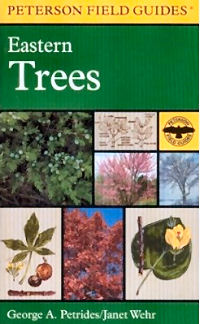
Eastern Trees: Peterson Field Guides

I enjoy reading both fiction and non-fiction, but over the years I've increasingly found myself drawn to non-fiction because I'm a constant learner and I feel that non-fiction feeds this "need" moreso than the average fiction book. With this said, each year I ask for a handful of books for Christmas and one year in particular I really wanted books about trees. I ended up receiving a book from my mom as well as from my husband's parents. The book my mom gave me was Eastern Trees, which is one of the Peterson Field Guides. The other book, the one from Mark's parents, was Dirr's Hardy Trees and Shrubs. This pretty much explains my family: my mom= self-taught botanist and Mark's parents= landscaping outfitters (they coordinate trees from nurseries to go to large landscape projects). While I enjoy both books, I enjoy them for entirely different reasons. Most recently, I've been glued to the Peterson Guide since I've been doing some recon in the local parks and wildlife areas.

The Peterson Guide to Eastern Trees is wonderful in that it breaks down the trees in the table of contents based on the characteristics of the tree, much like the Newcomb Wildflower Guide, only on a much less complex level. Immediately after this, there are a couple of pages that diagram the main parts of the tree and it explains the differences between needles, leave, leaflets and the various structures of buds. The next section includes a general overview of the overall structure of the trees-- silhouettes. This is particularly helpful for identification from a distance and also for when the leaves are no longer on the trees. After this section, there are charts with the characteristics of the trees and then color drawings on the opposite page to help the reader visually identify the tree by the leaves and the fruit/seeds/nuts. The last main section is the "species accounts" section. This section tells more about the individual species, where they're found, the trees' preferences and their uses for animals and people.

I have found myself particularly drawn to the silhouettes and the quick reference charts and drawings because they're so helpful in identifying the trees while in the field. With this said, I have not been drawn into the species accounts because it feels like it should be part of a separate book since the style is so different. I would probably have been more likely to read these accounts if they were linked in with the charts and drawings for the identification (like Newcomb's Wildflower Guide). As it is though, I've found myself using the Peterson Field Guide whenever I'm away from internet access, but then once I'm home, I can't help but be drawn to the internet's resources to answer my infinite questions about when the trees seed, what they're used for and where they're originally found. While most of this information can be found in the Peterson Guide, I also find that it feels merely surface level and I may be needing something a bit more in depth as my curiosity deepens.

Saturday, October 1, 2011

"The Girl Who Played with Fire"

I've been reading "The Girl Who Kicked the Hornets Nest"-- which is the second book in "The Millenium Series," but I've been struggling to make much progress with it. There are a few possible reasons for this: 1. I think just reading during my lunch and during DEAR (Drop Everything and Read) is not nearly enough reading for me. 2. Stieg Larsson must have had a contract that paid by the word. 3. I really must be a slower reader than I realize. With this said, I'm writing the review now even though I'm only 170 some pages in to the 500+ page monster. I know the story is decent as a whole, because I made a point to see the Swedish version of the movies (they'll be coming out soon in an English version too).

Why am I writing the review now? Well, in all honesty, I'm not sure that I can bring myself to finish the book in a timely manner (i.e. within the span of two months at this rate!). I've not just taken to reading the book when I need something to fill my time-- which is rarely, because I'm pretty good at keeping myself busy. Also, I feel like my impression of the book hasn't changed since the first 50 pages. So, what's my recommendation? Save your time.

I love the main character, Lisbeth Salander. She's an autistic misfit with a penchant for putting domestic abusers in their shameful places. However, for some reason Stieg Larsson decided to try to clean her up a bit by having her get a tattoo removed, take out some of her piercings and then get a boob job. Seriously, a boob job. Nothing goes more against the grain for everything Salander would have stood up for than a boob job.

My next bit of beef with the story... the sex. Seriously, I think Larsson was just looking for an excuse to write some lesbian love scenes and he was vicariously trying to live through Mikael Blomkvist, who happens to bed any dame in his proximity but never has to deal with much fallout in the way of jealous ladies. Again, Larsson couldn't sell me on this one.

Aside from the overdone sex forays and the boob job, the story has been decent enough: someone is out to murder Salander, her former abusive guardian is trying to figure how to get back at her, and the Millenium crew is hot on the trail of some corrupt officials who enjoy underage prostitutes. So, that part of the story is decent... it's just the other silliness that must be overlooked. So for now, this read will drop to the "bored and/or looking for something to read before bed" category. Sorry for your luck, Stieg.

Sunday, September 25, 2011

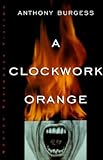
It's still working: A Clockwork Orange

On Fridays, I sometimes have my classes do "Booktalks"-- which are 3-5 minute informal speeches about something, anything that they've read. If a student isn't sure what to talk about he can always pick up a book or magazine from the classroom and simply read to us. It's really fun when students get excited and ham up the presentations. Some give wacky gestures and others just really use their voice changes to draw us in. This week, I was reminded of a book I read ages ago that my students have also found captivating: A Clockwork Orange by Anthony Burgess. Of course there is also a movie based on the book, but the book is a bit challenging and it doesn't get 'artsy' like the movie does.

Please be warned, the content of both the book and the movie may be quite disturbing to some, but the author does a great job commenting on society through the story and the sex and violence are necessary to get the point across. First, you must know that the author has adopted russian words (Anglocized of course) in order to convey a sense of slang words that the main character uses. This is a bit tricky for the first 20 pages, until you realize that mahlenki means little, balshoy means big, and krovy means blood. Also, the old "in-out, in-out" refers to sex. Believe me, there is lots of krovy and lots of "in-out".

The story is essentially this: Alex is the leader of a gang. His gang members are called "droogs". Alex and his gang are hoodlums who rape and pillage from whomever they choose. Finally, there is a challenge of authority from one of the droogs and the droogs sell out Alex. Alex ends up in some sort of asylum and he is forced to have "therapy" which involves watching violent and sexual videos while he is poisoned. Thus, Alex becomes conditioned to no longer be able to stand the sight of sex or violence. The story doesn't end there, because Alex encounters his droogs after he's released from his 'treatment'.

This book has long been a favorite with teens. Why? Is there sex and violence? Yes. There's also the challenge to authority and I think more than anything, teens especially love to read a story written from the "bad guy's" perspective. At least I know I do. And, it's nice to feel torn about whether a character is really "bad" or not. It's nice to read a story that actually has character development and this definitely has that.

Lastly, would I let my teens read this...? Yes. Would I let my teens watch the movie? Not until they'd read the book (and if they were over 17). This is the type of story that requires reflection or even "debriefing" because of it disturbing nature--which is what I think many teens are looking for with their reading; They're looking for answers and ways to experience the "dark side" without having to actually go to the dark side for the answers. This book is one way to do so.

Sunday, September 18, 2011

Whistling in the Dark: Potential Movie Material

Peer pressure can do amazing things and I, too, am sometimes a victim. However, peer pressure isn't always a bad thing and it wasn't for me this time. I ordered a copy of "Whistling in the Dark" (Lesley Kagen) because I read a quick synopsis advertising the staff's book club's latest choice. I was intrigued by the idea of the book because it indicated that it was a murder mystery set during the 1950s and a little girl was the narrator. As well, the narrator tries to protect herself and her sister and the synopsis indicated that the narrator knew who the "murderer and molester" was.

The first night I began to read the book, I was instantly sucked in because of the young narrator's tone. The young narrator is an eleven year old named Sally O'Malley. Sally has a 10 year old sister and an eighteen year old sister. The ten year old, Troo (which is short for her nickname, Trooper), is an outgoing, too-big for her britches, Francophile. She goes out of her way to say inappropriate things and come up with "plans" to make others bend to her every whim, and yet you can't help but love her because of her quick wit and take-no-prisoners attitude. Meanwhile, Sally is the reliable, responsible narrator who tries to keep Troo from getting into too many dangerous situations.

The girls' parental situation is a sticky one. The mother in the story is on her third husband (I think?) and at least her third lover. She has also been stricken with an illness that has left the children with Nell, the love-stricken oldest sister, and the drunken, carousing step-father, Hall. This means that Troo and Sally figure out meals on their own, which usually means showing up at friends' houses around dinner time, and the girls stumble into bed (or the bath) whenever they feel like it or when someone finally decides to take responsibility for them (which adds up to roughly once every week and a half).

In the meantime, a handful of girls in the neighborhood have disappeared and then grotesquely reappeared after being sexually assaulted and murdered. Sally has a close call two different nights and she's convinced that she knows who the murderer is, but she knows no one will believe her, not even her risk-taking little sister. While the reader comes to think of Sally as a reliable narrator because of her desire to avoid trouble (usually), we find out that Sally sometimes has an over-active imagination-- which is indicated through her family and friends' periodic remarks regarding her stories. As well, Sally is convinced that most of her peers, particularly her closest friends, are liars, and yet she claims them no-less.

There aren't many books I'll refuse to spoil the ending to, but this is one of those books. It's too much of a charmer to spoil. Its got witty dialogue, nostalgic images of bike parades and holiday celebrations, waitresses on roller skates, and 1950s music and television. While you'd think that the book would neglect some of the less-than-savory elements of the 1950s (racism and sexism), it puts them in their place as contributing evils-- particularly when characterizing the protagonists from the antagonists.

I enjoyed this book, but after reading another blogger's review, I was reminded that there were some annoying elements that felt a bit contrived and that's the diversity aspect. Believe me, I'm one for diversity and I love when authors actually include someone who isn't white, male and hetero, but the list of characters who were minor but randomly thrown in-- seeming like a school recruitment ad (you know, we've got a gay, a couple of black kids, a jew (or two) a Native American and oh and wait, someone with Down's Syndrome). The only way it could have been more forced was if there was a Latina and a Chinese neighbor. It felt like she wanted to do something with this show of diversity, but it never materialized, except that the discussion questions at the end of the book tied in some of these diversity elements, but very poorly. For instance, one question was: "13. Mr. Gary and Father Jim were gay. Did you find their relationship touching in any way?" I'm just not sure what to do with these questions at the end because I felt that they were pretty topical. And while the setting was a major metropolis, and these are diverse populations, it just seems peculiar that some of these characters had to be introduced with their stereo-typic qualifiers. I think the author may have been going for the child's point of view with trying to pidgeon-hole people, but it didn't quite work because there were other times when the thought processes for the narrator were obviously beyond that of a ten year old.

Despite this inconsistency in the narrator and the overreaching diversity, the story's tone was fun and yet scintillating. I would recommend the book, but not for those readers who take their reading too seriously. It's a light-hearted read. Put it in the Twighlight category; with much scrutiny it could be ripped to shreds, but for a secret read and for making a potential movie from it, it will appease the masses. And while the historic setting is ubiquitous, even to the point of some's annoyance, this is a great read for anyone- but the 45+ reader may get the biggest kick out of the references for the sheer nostalgia.

Monday, September 12, 2011

The Short Second Life of Bree Tanner: Twigh- Lite

I love knowing that a main character is going to die. Call it morbid, but it's a refreshing change from "happy-ever-after" endings and in particular it's a nice way for Stephanie Meyer to end "the short second life of bree tanner". I felt like Meyer was able to appease my "Pulp Fiction" loving side by writing a novella that was merely created to explain the lead up to a newbie vampire's death at the hands of the Volturi and the Cullenses.

I picked up TSSLBT only because a student brought it in to me and handed it to me to read. And, I'm a sucker for suggestions from my students-- particularly when they deliver the book to my desk. I'd read all four of the Twighlight books (again, because of my students' pressure and/or nagging), so I wasn't really feeling ANOTHER piece by Stephanie Meyer. I was worn out on love stories and for the glittering vampires, I just have to laugh a bit. However, while I felt like Meyer took her good old time building Bree's life as a vampire, I felt like she finally started to hit her stride once Bree was in the hands of the Cullenses and the Volturi.

The simple breakdown is this: Bree is a newbie vampire who is trying to figure out the characters of the other vampires in the clan she's been into. She goes hunting in a small group that varies every couple of days and she starts to trust on of the other characters, Diego. She and Diego bond over some of the bone-headed decisions some of the other young vampires make and ultimately these two start to figure out that the main leader of their vampire clan is using them, but they aren't quite sure what for. Come to find out that this clan leader is trying to build a mini-army of vampires to deal with some other vampires. (This is where the Cullenses and the Volturi come into play.)

Did the book make me feel like some of the vampires the Cullenses/ Volturi killed were innocent? Yes. I guess they didn't deserve it because vampires have feelings too, but as a whole I didn't really feel very emotionally attached to Bree even though she and her vampire-beau did figure out that light doesn't actually kill the Meyer's-version of vampires. I was hoping that Bree would get her head ripped off (seriously, there is lots of nonchalant limb-ripping in this book) and burned for something witty she might retort to the Volturi. Instead of feeling satisfied with having knocked out another YA lit. phenom, I felt a twinge for some Tarantino vampires (Think: "From Dusk 'til Dawn") in my life. At least with Tarantino's vampires, I can laugh at the gore and punchy one-liners.

Thursday, September 1, 2011

Meditative Read: Long Quiet Highway (by Natalie Goldberg)

I'm not really sure how I came across "Long Quiet Highway," but I found the book in one of my many book stashes. I'm sure that once upon a time I saw that Natalie Goldberg had written this and since I'd read "Wild Mind" and parts of "Writing Down the Bones", I knew I'd be in for a writing treat.


As an English teacher, I'm always looking for good books that teach about the writing process. While Wild Mind is more of a guide for topics to write about, "Long Quiet Highway" is part auto-biography and biography. The biography element tells about Goldberg's most influential teacher, her Buddhism teacher: Katagiri Roshi.


Goldberg describes her own restlessness in her quest for a purpose and in her marriage. Only through Buddhism and through her deepened interest in writing does she begin to gain a sense of quiet calm like her teacher. Goldberg's story is interesting in that it is multi-textured with her descriptions of childhood memories of classrooms, her parents and grandparents and the old-world ways, as well as her descriptions of New York, New Mexico and Minnesota.


This book is for anyone interested the writing process and the ways that writing teaches its students to dive inward for inspiration and for understanding.