Sunday, February 13, 2011

Wanting More of : The Waiting (Suzanne Woods Fisher)


As I've said numerous times before, friends and family love to recommend books to me because they know I talk with over 100 young readers a day (my students), so it's good to be versed in numerous genres and topics in order to encourage the reading 'magic' to happen. The latest book- yes, I believe in using the physical books because they don't burn up batteries or need charging- I finished, The Waiting by Suzanne Woods Fisher, was set in Amish Country in Pennsylvania. Who knew that Pennsylvania was such a hot place for book settings (see This World We Live In)?! I wasn't sold on reading the book, since I've grown such a fondness for reading about zombies and apocalypses. I gave it a try since my mom bought me a copy when she met the author again on one of her many birding escapades. Since getting involved with birding, mom has found herself in Amish Country (Near Ashland, Ohio) more than a few times, tracking down birds and sharing binoculars with Amish children. Therefore mom was particularly interested to hear my opinion of the book & the topic.

A couple of things struck me as fabulous about the book. First off, it made me cry. Not once, but three times! I'm not exactly a sappy person, but Fisher apparently found some of my soft spots (aside from the topic of Homelessness): Preparing for death with peace in the heart, loving so deeply that a person is willing to sacrifice his own wishes, & respect for God's creation/ destruction.

The basic story is this: A reluctant school teacher (Jorie) is waiting for her significant other to come home from the Vietnam War. Jorie's good friend, Mary Anne, finds out she has an aggressive form of cancer which will take her life in just a few weeks' time. Jorie finds out that her sig. other has passed away & his remains are returned to the family. Meantime, Mary Anne wants her husband to be happy and her children to be looked after, after her impending death, so Mary Anne urges her husband, Caleb (Cal), to marry Jorie once she finally succumbs to God's will (but Jorie doesn't know this). Caleb is reluctant to remarry and Jorie is seemingly the only female who actually encourages Caleb to take the time to let his heart heal before jumping into a new relationship/ marriage. The subplots include conflicts of the Plain (the Amish call themselves this) and the English, a loose cougar, and the comical relief of Caleb's desperate female suitors.

I've found myself talking about this book to friends and family constantly over the last week. My students can't believe that the book made me cry and my husband and I have been in numerous discussions about the poise of the Amish characters with trials and tribulations. It's easy to be hooked by the simplicity of life and it's refreshing to read a story with characters who are passionate about life and doing what's right for the group, rather than doing what's best for the individual. I think that the conflicts in this way are much more genuine than the average book out there right now; for instance, one character gets beaten mercilessly, but he refuses to report the beating because it's not the Plain way. Along these lines, the characters are actually developed into multi-dimensional characters. They are complex and even one of the seemingly "evil" character shows feelings and shows a new side of himself- and this is even more obvious because one of the "good" guys reacts to this transformation questioning the validity of the "evil" character's emotions.

After this reading experience (sobbing in my bed while reading and all!), I'm already interested in reading more of Suzanne Woods Fisher's work. It's just so refreshing to read something that isn't dealing with teenage pregnancy and drug use (but those topics have their places too) and to feel like the characters teach the audience positive ways to act and react to life and its ups and downs. I won't be forgetting this book anytime soon and expect to see more books from this series, The Lancaster County Series.

(Teachers: This book makes my short list of books to teach because there's substance for discussion, PG rating, and it's uplifting.)

Sunday, February 6, 2011

Susan Beth Pfeffer's: this world we live in *spoiler alert*


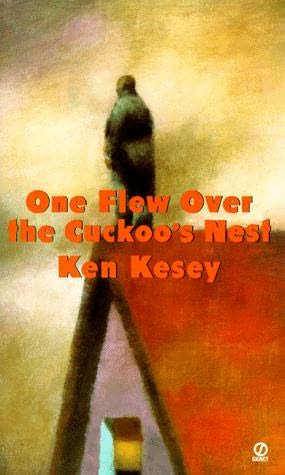
After trying to read One Flew Over the Cuckoo's Nest and giving up only 40 pages in, I was feeling a little disenchanted with reading. It's amazing how not being able to connect with a novel (or a professor or teacher, etc.) can kill any and all joy in a subject if you aren't able to connect. I'm also a bit thankful for such experiences because it reminds me that the vehicle for the message does matter; I once had a college prof make me hate Shakespeare within the first two days of his class, even though I'd been a life long Shakespeare reader. And while many people poo-poo quiting, I think that quiting creates opportunity, but there is some merit is sticking things out as well; but I found a long time ago that life is short and there are a lot of books out there to enjoy, so it's not worth 'sticking it out' unless the book is going to be used for a grade in a class. With that said, I ditched Ken Kesey and went back to my old steady, Susan Beth Pfeffer.


Susan Beth Pfeffer has managed to charm me with her post-apocalyptic series based on the moon getting knocked closer to the Earth. With the first and second book in the series under my belt (Life As We Knew It and The Dead and the Gone, respectively), I jumped in to This World We Live In whole-heartedly. My students know that I have a bit of a zombie & post-apocalypse fetish, so whenever a movie or a book comes out with these themes I get lots of recommendations- and thus I found out about the third book in the series. I got the book out Thursday morning and had it finished by Saturday night- which is unheard of for me since I'm usually grading till I'm blue in the face or I'm bouncing around between random other tasks- so consider this a strong recommendation for the book.


The story picks up with Miranda, a 17 year old girl, living in rural Pennsylvania with her mother and two brothers (they're the main characters from the 1st book, Life As We Knew It). They're scraping out a living since the previous year's apocalypse (the moon was knocked closer to the earth which meant screwed up tides, tsunamis, earthquakes, etc.). Jon and Matt, the brothers take a week-long trip to the river to catch fish and return not only with fish, but also a young woman nicknamed Syl, who Matt married while away for the fishing trip. Laura, Matt's mother isn't exactly pleased, but she welcomes Syl anyway and the family makes due. By some miracle never mentioned, Syl manages as a married woman but never becomes pregnant (which was my concern/prediction for the family).


Shortly thereafter, Miranda's father, step mother and newborn baby show up on the girl's doorstep. And, they're accompanied by a man named Charlie and two siblings from New York, Julie & Alex Morales (they're the characters from the 2nd book, The Dead and The Gone). the Evans household has now increased to 10 people and all of the characters realize that feeding 10 will be practically impossible unless desperate measure are taken. Hal, Miranda's dad, comes up with the plan to lie and say that the newcomers are all part of the deceased neighbor's family (Mrs. Nesbitt). With this lie, Hal & wife, baby, Julie, Alex & Charlie move into Mrs. Nesbitt's house, which is next door, and Hal & Miranda (Miranda is Hal's daughter) go to town to tell the city about the "Nesbitt family" having returned (this means that the newcomers are entitled to weekly bags of food).


Of course there's budding love between Julie and Jon and later between Alex and Miranda. The problem is that Alex has promised (his brother from Texas, who is a marine) to take Julie to a convent so that nuns may look after her and he plans to go live at a monastery in Ohio. Alex feels indebted to the Evans family and he wants to feel like he's earning his keep. Hal, Miranda, Alex and Julie make the trip to the convent only to find a lonely nun unable to take Julie. The four finally return to the Evans & Nesbitt houses to regroup. Alex and Miranda decide to run away with Julie to one of the safe camps. They let the family know that they're leaving and offer for others to join them, which the "Nesbitt" family decides to do, but not without a fight from the others.


The season finally starts to warm a bit and there are actually temperatures in the high 60s. (Which makes me think that the families could have at least begun to grow some cold weather crops, even if it was gray constantly.) Instead, the children continue to pilage houses throughout the town in order to find the basics before they leave for the safe camps. On the way home from such a trip, Alex and Miranda realize their minutes away from being hit by a tornado and they get home in time to warn their families.


The author throws a few unexpected twists in with the tornado and ultimately she lets the "hand of God" decide the fates of the characters, leaving the possiblity for a fourth book.


Wednesday, February 2, 2011

Went Crazy: One Flew Over the Cuckoo's Nest


I've officially tried to read One Flew Over the Cuckoo's Nest twice now. And, I gave up. I think I made it a whooping 40 pages in before I gave up. The book is on lists deeming it a classic, and I think I'll have to wait a while to see if it really holds up to those claims. So to justify my failure, here goes:

The story starts with a narrator telling about the various parts an unnamed Psych. Ward. A new patient has checked in and he's managed to ruffle numerous patients' 'feathers'. The new patient is a gambler and tries to "get to know" everyone right away- setting himself in a position to manipulate others and draw unwanted attention (which seems to be his main purpose in life).

The narrator seems to be one of the patients, who is silent, but seemingly sound of mind (since he's telling the story). There are other random snippets thrown into the story explaining the seemingly evil Nurse Rachet and her minions, three Black orderlies. The tones of abuse started from the beginning with the orderlies taking unruly patients to the shower rooms, and I wasn't sure that I could handle more mind-numbing images of abuses of patients. So, I stopped. I quit, looking for something more uplifting like a weather-apocalypse book: Susan's Beth Pfeffer's "this world we live in," which is the third book in the "Life As We Knew It" series.

Thursday, January 20, 2011

Muchacho by Louanne Johnson


My school librarian sent me home with Muchacho by Louanne Johnson as a bonus read for my Winter Break. Louanne Johnson also wrote "My Posse Don't Do Homework," which was the book turned into the movie Dangerous Minds. Johnson taught high school English before writing full-time and traveling.

I had no idea what to think about Muchacho until I finished the book since I'd only been told that it was supposed to be good.

Muchacho is about a young man named Eduardo (Eddie) Corazon. Eddie tells a disjointed story about his realization that he's actually an intelligent young man, who might even be able to make it out of his rough neighborhood and go on to get an education and make something of himself. Eddie starts to really realize this about himself as he describes how he met his girlfriend, Lupe.

The story jumps around a bit and "Eddie's" language can be a bit distracting (at least to an English teacher) because of "his" grammar.

Eddie keeps finding himself in trouble, but he secret affinity for books keeps him somewhat grounded. Eddie gets into writing poetry because of his enjoyment of reading and because his girlfriend is interested in poetry. After a few boneheaded, but somewhat well-intentioned moves, Eddie gets sent to stay with his refined bachelor uncle. Eddie gets involved with a local poetry reading and he, with the encouragement one of his former English teachers, actually seriously considers attending college.

While the book is heartwarming to English teachers, I can't help but feel that the story felt a bit contrived: lost teen finds reading, reading saves teen, teen becomes productive citizen. It just seemed a little too simplistic for me in that I kept hoping for a good solid, gut-wrenching conflict and I was left with surface level conflicts that barely compelled me to keep reading. I felt the story was written more for gullible, starry-eyed English teachers rather than conflicted teens.

Saturday, January 1, 2011

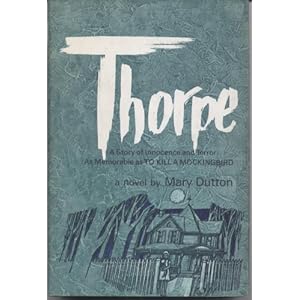
Retro Read: Thorpe by Mary Dutton * pseudo spoiler alert*


One of my students nearly came unglued when I told her I'd never heard of the book Thorpe by Mary Dutton. The next day this students brought in a tattered green hard-cover book and left it with me without asking how long it'd take me to read it. I wasn't excited about reading the book because I didn't know anything about it-- only that one of my students, who is a prolific reader herself, was adamant that I must read it. She insisted that is was along the lines of To Kill a Mockingbird, but it was better. After a month and a half of letting the book ferment on my counter of random school papers, rubrics and other less-than-urgent tidbits, I finally took the book home and put it on the bottom of my Christmas reading list. (I know, I'm terrible! I'm just concerned that she trusted me to actually read it after having it for so long.)

The story started slowly. Too slowly for me. I trudged through the little girl's mundane 1940s school days with getting muddy with her older, wiser brother. There were racial tensions, but I kept looking for when the story might actually take off. Give me conflict and give me conflict from the beginning. Life's too short for me the read 100 pages before getting to the gist of the story. I'm a little too much like a teenage boy sometimes when it comes to things like reading. Give me zombies, blood, guts, war, and just enough of a relationship to make things fun, but don't let the relationship take over the story. Anyway... 1940s, segregated Arkansas.

I finished the book last night, after a large lapse in motivation... like I'd said, it started too slowly for me. But, determined to cross the book off my list and with only 45 pages left, I grudging jumped back in. I wasn't disappointed.

The story had been slow going previously with the main character Thorpe still setting the stage for the main event. Thorpe's family had essentially been on a downward spiral because her father, a school principal had lost his job because he'd given books to a bright, young, black neighbor. The local good-ol' boys had created a stink and Jim Torrance (Thorpe's dad) quit because he was determined to work an honest job free from local racial politics.

Thorpe and her brother James had been playing a lot with some neighboring "nigra" children- Thee & Josie. Josie, who's only 13 gets raped by a racist, "poontang" chasing good ol' boy. Josie, doesn't even realize what's happened until the doctor finally puts it together for the family (several months in to the pregnancy).

Thorpe increasingly gets harassed by other school children and by a white-trash neighbor family for hanging out with Thee. It finally culminates into Venie (Thorpe's mom) essentially bribing Thorpe into keeping her mouth shut about hanging out with Thee, all while Venie sends mixed messages to her children about race. Venie seems to care deeply for her black neighbors (Donie, the mother, it Venie's washer-woman) but she also tries to get her children to understand that their inter-racial friendships are creating hardships for both parties. This tension continues for sometime.

At page 200 the book decides to implement real action rather than just talk and Thorpe's overhearing adult conversations (and often misinterpreting them).

Meantime, Jim is being pressured by the local Ku Klux Klan to ride with them in order to get his job back- which he refuses repeatedly, but becomes more tempting as the family is given charity food from some KKK members.

Thorpe visits her black neighbors sparingly and with reservation. However, she visits one day and goes down to the nearby river/ watering hole with Thee and Josie and the white-trash family's kids are all there taunting Thorpe, Thee and Josie. It culminates in Thee jumping in to the "Mouth of Hell" to prove he's not chicken, even though he can't swim. It's easy to see what's going to happen...

A little foreshadowing shows up in that Thorpe keeps talking about a neighbor house being "ghosted" because of someone being hung in the yard. Thorpe's obnoxious cousin, Dawn Starr, stays with Thorpe in order to distract the family from the recent tragedy. Thorpe, annoyed with Dawn Starr and hoping to scare her, takes Dawn down to the "ghosted" house. Sure enough, the "ghosts" are out and on their horses. They're also whipping someone...

While the book was an extremely slow start, the message(s) was quite interesting. It was refreshing to read a story that didn't show the reader a clear cut path to solve the woes of racism. I appreciated the reality. It showed the ways pride and vanity could really harm families- as well as how racism was able to persist- despite "good" people disagreeing with racist ideologies. My suggestion, for reading it, skip pages 50-150 and you won't miss much. You'll get enough background to get a flavor for the culture and you'll get to the message(s) much faster.

Hunger Games: still hungry


I've had numerous students and fellow teachers recommend Hunger Games by Suzanne Collins to me. I finally broke down and read it over my Christmas Break. It only took me a couple of days to finish (which is good for me, because despite being a big reader, I also have difficulty reading the same thing more than an hour at a time). I could see why my students had been begging me to teach the third book in the series, Mockingjay, because many of them had read the first two last year in one of my colleague's classes. So, I bit the bullet.

Hunger Games reminded me of The Uglies (Scott Westerfield) combined with a season of Survivor. The setting is a futuristic North America, that has been broken into 12 districts and a Capitol district.

The protagonist is Katniss Everdeen, who is nicknamed "Catnip" by her good male friend, Gale.
Katniss and Gale are hunting buddies, even though hunting is technically illegal in their district. The government dictates what each district should provide for the nation and Katniss's district, district 12, produces the nation's coal.

After a brief introduction to Katniss, we find out that she is essentially the head of her household because of a mining accident that killed her father and traumatized her mother. Therefore, Katniss has done all that she can- legal and illegal- to provide for her little sister (Prim) and her mother.

Katniss becomes an unlikely hero in that she sacrifices her peace and welfare for Prim by taking Prim's place at the Hunger Games. The means that Katniss will now be fighting for the death against 23 other competitors to gain winnings for not only herself, but for her district.

Of course there must be some love tensions in the story- otherwise the romantic readers would be neglected. Katniss finds herself torn between Gale- who wants to run away from district 12- and Peeta- who is a fellow competitor from her district. Katniss and Peeta are pushed together by the district 12 mentor and the stylists, who try to help the two teens to win the crowd in order to gain sponsors for their survival during the competition. Despite Katniss's disagreements with her mentor, she unintentionally manages to woo the crowd- which results in some powerful help when the going gets rough.

Once actually at the Hunger Games, Katniss and Peeta split, because they're supposed to kill one another. Alliances are made among various groups and Katniss keeps her distance from all of the others for as long as possible. While in the Games, Katniss sleeps in trees, gathers food, and even creates problems for challengers with hornets. Never does Katniss kill another competitor in cold blood, but she's definitely adept at self defense and hunting.

The story is unpredictable in all but it's end because alliances and friendships are made and destroyed. The reader can also marvel at the creativity of the author in that she creatively kills competitors off and creates a cruel government the encourages the blood sport. While I enjoyed the read, I was left a little disappointed because it was so obvious that Katniss would win. I'd really like to see the politics of the story be brought out more and I can't help but wonder if the second or third novel will involve Katniss challenging the government. This is a way that I would have liked to see Katniss challenge the government even more than she does, but I guess I'll just have to put book 2 & 3 on my list to see if my opinion improves.

My Sister's Keeper- *spoiler alert*


In addition to my Christmas shopping sprees, I've also been on a mini reading spree. During breaks from teaching I usually make it my mission to catch up on a few books that I've been promising to myself that I'd read. One of these was My Sister's Keeper by Jodi Picoult. I was reluctant to give it a try because the numerous students who'd recommended it to me had a penchant for sappy Nicholas Sparks novels. The real reason I finally gave it a try was that I felt it was my duty to test it out because the topic of organ harvesting kept coming up in my class as my health tech students have been working on writing research papers connecting with health technologies.

I knew the book was about a little girl who was intended by her parents as being a donor match for her older sister, who had a form of childhood cancer. I also knew that the younger girl wasn't crazy about the "donations" she was "asked" to make for her sister because of the sheer intrusiveness of the procedures.

As I read, I found that the book was organized by chapters written from each character's perspective, except Kate's (the older sister who we finally hear from near the end). The story begins with a young woman/girl (approx. 12ish) named Anna who is in the process of saving up and purchasing the services of an attorney because she would like to have the legal right to her own body. As the story progresses, the reader finds out that Anna is a very mature young woman who has essentially been domineered by her parents love for her older sister, Kate. The middle child, Jesse, is a juvenile delinquent who has a fondness for arson. This is particularly ironic because his dad is a firefighter who has been trying to catch a pesky arsonist (his son).

While Anna toils with her decision to liberate herself, but essentially sign her sister's death certificate, the reader is able to see how much influence parents really do have on their minor children. The reader also becomes acquainted with Anna's lawyer, who has a service dog named Judge, and the child advocate who happens to have ridiculous sexual tension with the lawyer because the two had had an abrupt and unresolved breakup while dating in college.

The story is genuinely compelling because it's easy to see how Anna's parents are being divided by Kate's chronic illness(es) and the sexual tension gives the romance readers a little something to look forward to. It's also easy to see how Anna become dehumanized because of Kate's extreme threat of mortality.

The entire story pulled me through the pages because I was curious to see just how Anna was going to end up if she did win the case. She was definitely in a Catch-22 situation, so I was hoping the author was going to pull a clever ending together despite the appearance of a no-win situation. What's the author's solution? Deux ex machina. I saw it coming, because she'd dug herself too much of a hole. All bridges were burnt, so there was only one way out.

Was the read worthwhile? Yes-- because it explored a topic that many people may have otherwise never considered and it approached the topic through a relatively unbiased lens by involving so many characters' perspectives. Was is literary genius? Hardly. But, I can cross it off my list and I would recommend it to those readers curious about the topic or simply looking for a Nicolas Sparks stand-in.