Friday, July 1, 2011

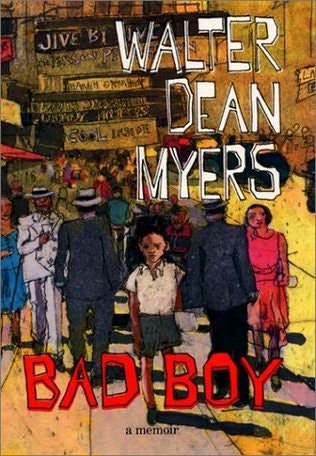
Walter Dean Myers is "Bad Boy"

I must admit that I've recently been sucked into the tv series Dexter and I feel that right now many stories will simply pale in comparison to the storyline of this show. My husband and I have been compulsively watching it over the past three weeks and was thrilled to see it based on a book: Darkly Dreaming Dexter. This may need to make it onto my list once I make it through my summer stack. With this said, I have been reading when I haven't been recovering from my daily distance running...

I picked up this biography by Walter Dean Myers because he's written a few books I absolutely loved: Fallen Angels and Monster. Both won numerous awards for YA lit. Myers' biography is a mere 205 pages. Above all it's packed full of his love for reading and writing.

Myers recounts his shaky school history and his history of fighting and sports addiction. While I appreciated his attempts to connect with troubled youth and aspiring writers, I felt that his book was speaking to two disconnected audiences. His first audience is the troubled youth, who gets into fights, skips schools but still manages to have parents who care. His second audience is for those who love reading. While he attempts to combine these audiences, it seems that he perceives them as disconnected. The conflict of the book is just this: his struggle with being a troubled but bright youth who enjoys reading. It's funny, but I feel like he should have written "the First part Last" because of his self descriptions.

While there are numerous authors from backgrounds different than my own that I've been able to connect with, I had a hard time connecting with "Bad Boy." I'm an avid reader and I have definitely found myself less than pleased with school, and at times I found myself doing reckless things just because I could. And yet, I felt disconnected. It seemed that he was telling the story from some perspective outside of himself which relied on dates and facts more than emotions and memories.

Like most people, I too, have struggled with identity. And I feel that most of us have. Have I struggled with racial issues during the time of civil rights? No, but I've read other authors who have similarly toiled and been able to continue to relate to the reader. Audre Lorde, James Baldwin and Sherman Alexie all come to mind.

There were many points in the book when I felt like Myers was recounting many of the books he read and too much about the books he read. It made the story feel cataloged. While I, too, have enjoyed reading, I can't say that I could remember the exact book I was reading at a particular time for more than 5 times in my life, yet Myers does this about 20 times. It gets a bit cumbersome because the books aren't meaningful to his overall struggle- which is reconciling being a bright, but trouble black youth, who is emerging as a writer, when writing was not an option as a career.

I'd give Myers a "C" for his work because I felt that it fell flat as far as passion and humor, particularly based on the work I've previously read by him. I'm not judging his life, but I just felt that something about the book did not compel me to continue to read. For being such a short book, it took me nearly a week to push myself to sit down and just read it.

Sunday, June 26, 2011

Short & Sweet: Dead Girls Don't Write Letters (pseudo-Spoiler Alert)

I, being the commitment-phobe that I am, decided to find the shortest book I had out on loan in order to cleanse my mental palate from the last two literary duds. It worked. Dead Girls Don't Write Letters by Gail Giles was a short, skin tingling thriller. I read the book in one sitting (which is highly unusual for me) because it was a perfect 105 pages long.

The premise is this: Sunny, which is short for Sunflower, is a teen who is trying to deal with an alcoholic father and a shock-induced mother. Sunny's older sister, Jasmine, has been killed in a fire in New York. While Sunny's life wasn't exactly peachy with Jasmine around, Sunny manages to go through the motions with her school work and taking on family responsibilities. Then, Sunny manages to find a letter in the mail from her sister that is dated post-firey-death. Sunny's hesitant to open the letter, much less share it with her parents, because she's afraid it will just open the fresh wounds wider. She does open the letter and then finds out that Jasmine is apparently alive and going to be visiting in the very near future (within two days of receiving the letter). Sunny is guarded because she knows that Jasmine wasn't the angel everyone else thought she was.

Sunny's parents are thrilled at the news and Sunny's mother suddenly snaps out of her funk and begins to cook and clean as if it were Thanksgiving. The only problems is that when Jasmine arrives at the house, Sunny realizes it's not Jasmine. It's an imposter. Sunny plays it cool until she has a moment to speak with her father privately- who is also acting peculiarly because he can tell that this girl is not the same "Jazz" the family knows. Sunny's mother is in perfect denial even though the little signs have indicated that this "new" and nicer Jazz is not legit.

Sunny and her father team up to deal with the imposter, but it's obvious that Sunny is less than forgiving of her father's drinking and there's serious tension along the way. Sunny and her family deal with the imposter... but then we find out there's reason to believe that maybe there wasn't really an imposter... or maybe there was an imposter and she's a threat again. Either way, the open-ended ending is satisfying in that there's the possibility for a follow up book. Kudos Gail Giles. You kept me reading in a time a reading-need and you didn't bog me down with unnecessary details. I won't forget your name when I skulk through the library annoyed at an inept author and I need a decent writer to pull me out of the funk of being recommended lacking storylines.

Saturday, June 25, 2011

will grayson, will grayson: repetition & texting filler

Every year, at the end of the school year, I load up on summer reading books from my school library in attempt to get in touch with the latest YA lit. Sometimes I find some wonderful reads and sometimes I find myself attempting to poke my eyes out rather than finish a weak book.

I guess I found another eye-poker. It seems like I've been on a blah-book run lately and I apologize as much as anyone. However, I'm hoping to spare future readers from my mistakes; so, live and learn. With that said, will grayson, will grayson by John Green and David Levithan should be put at the bottom of anyone's reading list. I've tried to read John Green's work before and got so bored I put it down as well (An Abundance of Katherines). This work, with David Levithan's help (author of Boy Meets Boy- which was OK and super short), also fell flat. My main complaint: I just couldn't connect with the characters. I felt no compassion for them and I didn't feel as if they were really encountering conflicts that made me want to continue to read. I felt that Green and Levithan were so focused on describing how often the characters used their computers and cell phones for IMing or texting that they forgot to focus on the story.

The story is told from two perspectives: two young adults both named Will Grayson, who both live in the Chicago area. The two young men happen to meet one another because of a fake blind date. One man is straight and the other is gay. Both are trying to find their ways in new, pseudo relationships. After 210 out of the 305 pages I just simply gave up out of boredom. I just didn't feel like I was going to learn anything from the characters- which is an automatic way to turn me off. I didn't feel like I really learned anything about Chicago or Chicagoans, and I didn't feel like I learned anything more about being a gay teen (or being a straight teen for that matter). Instead, I felt like there was an unnecessary abundance of lyrics for Tiny's musical and lovey-dovey boys reasssurring one another in order to build self esteem. I feel that I'm doing myself and the reader an injustice because by my description it could appear that there's actually substance to the book, but please don't be fooled; it's simply authors trying to imitate teen life with pithy one liners. I feel that this book is an insult to the teens I know and work with. Their feelings are real and are compelling. Their struggles are gut-wrenching and difficult. It's time some authors started to respect and reflect that.

All I can say is that this book makes me miss reading Suzanne Woods Fisher (The Search, The Waiting, etc.) and Alexie Sherman (The Almost True Story of a Part time Indian) because they know how to describe emotions and tie these emotions to compelling conflicts.

Thursday, June 16, 2011

Just another baby book: The First Part Last

Well, I got my cheap and easy YA lit. read in for the week: The First Part Last by Angela Johnson. The book is a Michael Printz Award winner, but I can't say that I was overly impressed. I felt like it was just another book with a teen raising a child before he was ready.


The book is interesting in that it jumps forward and backward in time and it's a one-day read. It's only 130 ish pages- which are a quick read. The main character, Bobby is a 16 year old inner-city New Yorker who gets his 16 year old girlfriend, Nia, pregnant.


I did find it interesting that the main characters talks about all the ways that his parents had talked to him about sex and preventing STDs and pregnancy and yet the teen still ends up a young parent. Bobby talks about the difficulty of raising the child with minimal parental support (despite them being really strong parent for him they're really pushing him to take responsiblity). Bobby also talks about his love for both the baby and his girlfriend (and there's a big twist as to how he ends up the sole provider for the child).


I'm not sure what the author is trying to convey about teen pregnancy. I think she may be pushing for teens to own up- but I'm not sure that this is always the best choice for the baby & thus the community. It seemed to me that Bobby just naturally knew how to care for his baby and there was very little discussion about learning how to discipline, care for the baby, and learn how not to snap on the child. Instead, it seemed that the book reinforced what so many of my students express: Every thing will just work itself out, teens don't really need guidance, babies are how you get attention, and babies are how you solve relationship problems. While the author did demonstrate the young father's desire to goof off and needing to sacrifice these feelings in order to be responsible, I couldn't help but feel that the book wasn't giving young people the needed guidance: which could have more effectively been spreadsheets of the costs, time demands, legal responsibilites, and experiences sacrificed in order to truly be a good and effective teen parent.


Maybe I'm just too jaded from seeing teen pregnancy with multiple students, but the story was myopic and didn't really have a conflict. The conflict should have been "is Bobby going to keep the baby, even though he's not ready for it?" But it wasn't, because we knew from the first page that he would end up with the baby. Instead the conflict for me was: "why in the heck is the author just showing the excitement a new baby brings? This contradicts what we want teens to learn. "


What teens need to be given are examples of characters who are tempted to make the wrong decisions but instead, find creative ways to make positive decisions. We've got plenty of negative role models, but it seems young adults have the hardest time recognizing the positive role models. Instead, YA readers get sexed up, drugged up, vampired out, when they should be getting the strength needed to tell their parents and teachers the truth or ask for adult guidance with tricky situations; they really need the strength and guidance as to how to indentify abusive relationships and knowing when just fooling around really means getting oneself into situations with long-term consequences. At the same time it seems that parents and teachers need the positive role models as well, to know how to help guide their young adults to wise decision making, while realizing that young adults (like anyone) love attention, so we'd better be giving them attention and support for their positive deeds and courageous acts- not just attention when they OD, get pregnant or crave human blood. It makes me think that we need a few more parents and teachers like those in the movie Easy A (great examples of easy-going but concerned, supportive parents & an English Teacher). I know it's just a movie, but check it out and you'll know what I mean.


Tuesday, June 14, 2011

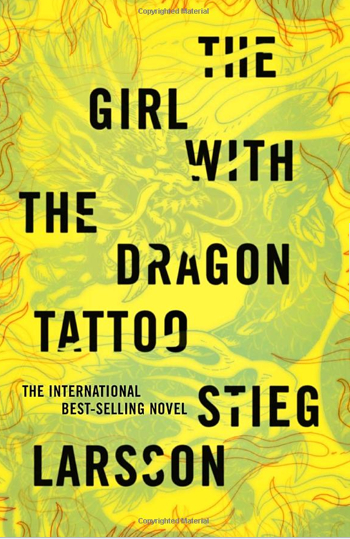
Savor-worthy: The Girl with the Dragon Tattoo

Some people read the book first and watch the movie second. I ALWAYS (when possible) read the book after I watch the movie. Some would say this spoils the book, but I disagree; the book is always better than the movie, so I find myself rarely disappointed. Instead, I use the movie-version of a story to whet my appetite and I then seek out the book to fill in the interesting details the movie couldn't include. I also get interesting character insights from the book that the movie was unable to tackle or was too confined to begin to tackle the topic. With this said, I read The Girl with the Dragon Tattoo after I'd seen the swedish version of the movie (with English subtitles). Apparently, there's supposed to be an English version in the making as well.


I kept hearing about TGDT (my new abbreviation for it) on NPR and from my artsy, indie friends. The story was written by Stieg Larsson, who passed shortly after having the trilogy published. I heard TGDT was fabulous, but then came the disclaimers: do not watch or read this if you're squeemish about sexual violence-- because this theme pushes the entire conflict. As well, when I heard about it on NPR, I was reassured that the sexual violence is necessary to the plot and that the main character gets vindication (which helped me stomach one scene in particular).


The gist is this: Lisbeth Salander is a punk-rock (minus the rock) investigator. She makes her own hours and her own rules. She's also a warden of the state... which the book never explains (but gets explained later in the TGDT aka Millenium Series). We catch up with her at the point when her state guardian dies and she's assigned a new, sexually sadistic state guardian.


Meantime, Mikael Blomkvist is a financial reporter who's recently lost a libel lawsuit and he's baited by the head of the Vanger family to write a chronicle of the family (publically) and attempt to solve a 30 year old disappearance mystery (secretly).


Lisbeth and Mikael become an unlikely pair after Mikael makes enough progress on the mystery to realize that he's in over his head. He enlists Lisbeth because he read the thorough, and unsettling report she wrote for Mr. Vanger in order to assure Vanger of Blomkvist's skill and ethical standard.


The story is both sexual and a bit gory, but it's far from unintelligent. The story has a strong plot that holds up to it's (at times) unnecessary wordiness. At 630+ pages, I couldn't help but want to chew out Larsson's editor for not requiring him to cut out 200 or so pages- particularly unnecessary info about what type of sandwiches the characters ate as well as an diatribe about a Swedish tycoon via an explanation of the Swedish banking industry. However, I slowly wandered through the story because it had intrique: Why was the Harriet Vanger missing? And then, what did these other brutal murders have to do with her- if her body was never found? I couldn't help but be sucked in, but I decided I was also ready for some cheap and easy YA lit. reading immediately after this commitment-of-a-book was concluded.


Monday, May 23, 2011

Talking Dirt: Annie Spiegelman

Apologies for my hiatus: I've just recently been finishing off my master's research project (about student's learning grammar). Nonetheless, I'd been reading when I could squeeze the time in between the various drafts of the paper. In honor of spring and my apartment's balcony garden (strategically designed to be Zombie-free), I dug into a bargain book called "Talking Dirt" by Annie Spiegelman. I wasn't familiar with this author at all, but I was drawn to the book because of the title and simply because I wanted something fun to read but super informative.

I hoped reading a bit of non-fiction would help my gardening skills along the way. I enjoyed Spiegelman's non-chalant and non-intimidating approach to gardening, but at times she was a little annoying and overly self-centered. While I appreciated her attempts at humor, her editor should have encouraged to cut her snarky commentary in half. First off, she dogs Carl Linneaus, and while I appreciate her point of view, she comes off a insulting her beloved hobby because latin names are such a big part of understanding the varieties of plants and how they're related. Even though I'm a newbie, I recognize that much from basic science schooling and language background. As well, it seemed that every other page Spiegelman was concerned about the reader(s) sending her hate mail or cursing her name if some bit of her advice didn't pan out as she'd suggested. Rather that being comical, it just started to seem self-absorbed and ego-centric.

On the positive side, Spiegelman did urge organics and explained some of the links between chemicals and the problems with constantly thinking that chemicals would be the answer. I also appreciated her repetition in pushing for mulch, compost and application of these in order to create a stronger base rather than chemically dependent plants. Her chapters were also broken down into very manageable chunks which made the reading very digest-able. This reading simply whetted my appetite for more gardening projects and eco-reading... which will be coming in the near future when I stock up on my summer reading. Also coming up soon: The Girl with the Dragon Tattoo Series and Water for Elephants.

Friday, April 15, 2011

Intermittant Read: The Zombie Survival Guide (Max Brooks)


This spring has been chaotic (hosting a student teacher & working on a master's research paper), so I've found myself intermittently reading The Zombie Survival Guide by Max Brooks. He's also the author of WWZ (World War Zombie) which is slotted to be made into a movie starring Brad Pitt. The Zombie Survival Guide is meant as a companion to WWZ and is meant as a comical survival guide modeled after the many military guidebooks put out to help personnel prepare for various survival and war-time situations (think Field Manuals).

The Survival Guide covers how to prepare for various terrain (and which terrain to avoid at all costs), the best weapons and the best strategies for survival (not heroics!). The pictures are amusing and very reminiscent of the Army Field Manuals' cheesy depictions. However, instead of covering operations of dealing with terrorism or chemical warfare, the operations discuss the best methods for evading zombies (AKA ghouls) and the author even brings in some "first-hand" accounts to help explain why the guide suggest various tactics or weapons.

While some might find the idea of a zombie apocalypse terrifying or comical, the book is great for a mental evaluation of what anyone could/should do in any sort of chaotic every-woman-for-herself type situation. It's a fun little mental test to decide how prepared you would be if things "got real." And the truth be told, when I'm usually busy thinking about grammar research and lesson plans, sometimes I just like to envision myself as "Alice" from Resident Evil to take that brief trip from reality.